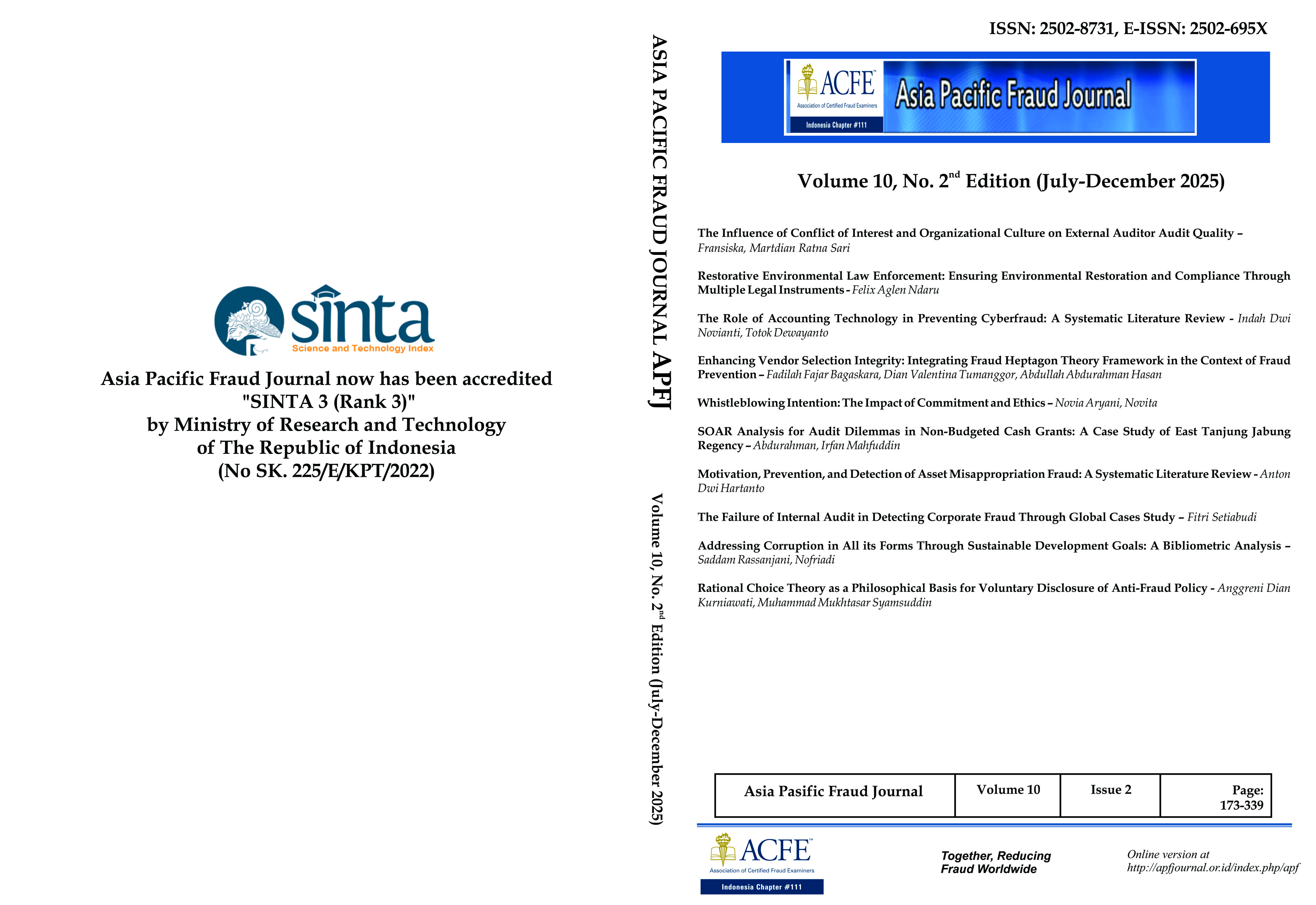
Addressing Corruption in All its Forms Through Sustainable Development Goals: A Bibliometric Analysis
DOI:
https://doi.org/10.21532/apfjournal.v10i2.407Keywords:
Anti-Corruption, Bibliometric Analysis, Bribery, Corruption, Global Perspectives, Public Trust, Research Trends, Sustainable Development GoalsAbstract
Corruption is a significant obstacle to sustainable development, weakening governance and public trust while deepening poverty and inequality. This paper examines global views on fighting corruption in all its forms through the lens of the Sustainable Development Goals (SDGs). Using bibliometric analysis in VOSviewer, the study reviews 112 scholarly articles across diverse disciplines to identify key trends, influential studies, and gaps in current research. The findings indicate an increasing academic interest in the relationship between corruption and sustainable development, with notable contributions from the UK, the US, and South Africa. The analysis underscores the crucial role of anti-corruption initiatives, particularly those aligned with SDG 16, in advancing the broader SDG agenda. By identifying emerging themes and overlooked areas, this study provides insights that can inform future research and strengthen cooperation among governments, civil society, and the private sector to promote transparency, accountability, and effective governance.
References
Abhayawansa, S., Adams, C. A., & Neesham, C. (2021). Accountability and governance in pursuit of Sustainable Development Goals: Conceptualising how governments create value. Accounting, Auditing & Accountability Journal, 34(4), 923–945. https://doi.org/10.1108/AAAJ-07-2020-4667.
Adam, I., & Fazekas, M. (2021). Are emerging technologies helping win the fight against corruption? A review of the state of evidence. Information Economics and Policy, 57, 100950. https://doi.org/10.1016/j.infoecopol.2021.100950.
Ahmed, A., & Anifowose, M. (2024). Corruption, corporate governance, and sustainable development goals in Africa. Corporate Governance: The International Journal of Business in Society, 24(1), 119–138. https://doi.org/10.1108/CG-07-2022-0311.
Ashta, A. (2021). Towards a New Form of Undemocratic Capitalism: Introducing Macro-Equity to Finance Development Post COVID-19 Crisis. Journal of Risk and Financial Management, 14(3), 116. https://doi.org/10.3390/jrfm14030116.
Aziani, A., Ferwerda, J., & Riccardi, M. (2022). Who are our owners? Exploring the ownership links of businesses to identify illicit financial flows. European Journal of Criminology, 19(6), 1542–1573. https://doi.org/10.1177/1477370820980368.
Baas, J., Schotten, M., Plume, A., Côté, G., & Karimi, R. (2020). Scopus as a curated, high-quality bibliometric data source for academic research in quantitative science studies. Quantitative Science Studies, 1(1), 377–386. https://doi.org/10.1162/qss_a_00019.
Bahoo, S., Alon, I., & Floreani, J. (2021). Corruption in economics: A bibliometric analysis and research agenda. Applied Economics Letters, 28(7), 565–578. https://doi.org/10.1080/13504851.2020.1764476.
B?k, P. (2020). Economic analysis of corruption at the company level. Central European Economic Journal, 7(54), 186–204. https://doi.org/10.2478/ceej-2020-0015.
Borlini, L. (2024). Monitoring and compliance mechanisms as a diagnostic and prognostic tool of international anti-corruption cooperation: A data-driven study. International Journal of Constitutional Law, 22(2), 487–513. https://doi.org/10.1093/icon/moae033.
Bozhenko, V., Boyko, A., & Voronenko, I. (2023). Corruption as an Obstacle of Sustainable Development. In W. Strielkowski (Ed.), Leadership, Entrepreneurship and Sustainable Development Post COVID-19 (pp. 395–407). Springer Nature Switzerland. https://doi.org/10.1007/978-3-031-28131-0_27.
Chang, C.-P., & Hao, Y. (2017). Environmental performance, corruption and economic growth: Global evidence using a new data set. Applied Economics, 49(5), 498–514. https://doi.org/10.1080/00036846.2016.1200186.
Damijan, S. (2023). Corruption: A Review of Issues. Economic and Business Review, 25(1), 1–10. https://doi.org/10.15458/2335-4216.1314.
Donner, E. K., Meißner, A., & Bort, S. (2025). Moving from voluntary to mandatory sustainability reporting—Transparency in sustainable development goals ( SDG ) reporting: An analysis of Germany’s largest MNCs. Business Ethics, the Environment & Responsibility, 34(3), 900–911. https://doi.org/10.1111/beer.12687.
Frolova, I., Voronkova, O., Alekhina, N., Kovaleva, I., Prodanova, N., & Kashirskaya, L. (2019). Corruption as an obstacle to sustainable development: A regional example. Entrepreneurship and Sustainability Issues, 7(1), 674–689. https://doi.org/10.9770/jesi.2019.7.1(48).
Gans-Morse, J., Kalgin, A., Klimenko, A., Vorobyev, D., & Yakovlev, A. (2022). Public Service Motivation as a Predictor of Corruption, Dishonesty, and Altruism. Journal of Public Administration Research and Theory, 32(2), 287–309. https://doi.org/10.1093/jopart/muab018.
García-Sánchez, I., Rodríguez-Ariza, L., Aibar-Guzmán, B., & Aibar-Guzmán, C. (2020). Do institutional investors drive corporate transparency regarding business contribution to the sustainable development goals? Business Strategy and the Environment, 29(5), 2019–2036. https://doi.org/10.1002/bse.2485.
Georgeson, L., & Maslin, M. (2018). Putting the United Nations Sustainable Development Goals into practice: A review of implementation, monitoring, and finance. Geo: Geography and Environment, 5(1), e00049. https://doi.org/10.1002/geo2.49.
Gillanders, R., & Neselevska, O. (2018). Public Sector Corruption and Trust in the Private Sector. Journal of International Development, 30(8), 1288–1317. https://doi.org/10.1002/jid.3306.
Hasnas, J. (2018). The corruption of the rule of law. Social Philosophy and Policy, 35(02), 12–30. https://doi.org/10.1017/S0265052519000074.
Herre, B., Samborska, V., & Ortiz-Ospina, E. (2016, October). Corruption. Our World in Data. https://ourworldindata.org/corruption.
Hunter, M., Uwaydah Mardini, R., El-Seblani, A., & Elsayed, S. (2020). Anti-corruption, Transparency and Accountability: Case Study of Healthcare in the Arab Countries. Global Health Action, 13(sup1), 1704529. https://doi.org/10.1080/16549716.2019.1704529.
Joseph, C., Gunawan, J., Madi, N., Janggu, T., Rahmat, M., & Mohamed, N. (2019). Realising sustainable development goals via online integrity framework disclosure: Evidence from Malaysian and Indonesian local authorities. Journal of Cleaner Production, 215, 112–122. https://doi.org/10.1016/j.jclepro.2019.01.057.
Kachur, V., Khomiachenko, S., Moriak-Protopopova, K., & Protosavitska, L. (2020). Legal Culture as a Condition for Sustainable Development of Ukrainian Society. European Journal of Sustainable Development, 9(4), 211-218. https://doi.org/10.14207/ejsd.2020.v9n4p211.
Knapp, S., Franses, P. H., & Whitby, B. (2021). Measuring the effect of perceived corruption on detention and incident risk in the maritime industry – An empirical analysis. Maritime Transport Research, 2, 100031. https://doi.org/10.1016/j.martra.2021.100031.
Kohler, J. C., & Bowra, A. (2020). Exploring anti-corruption, transparency, and accountability in the World Health Organization, the United Nations Development Programme, the World Bank Group, and the Global Fund to Fight AIDS, Tuberculosis and Malaria. Globalization and Health, 16(1), 1-10. https://doi.org/10.1186/s12992-020-00629-5.
Kratcoski, P. C. (2018). Introduction: Overview of Major Types of Fraud and Corruption. In P. C. Kratcoski & M. Edelbacher (Eds), Fraud and Corruption (pp. 3–19). Springer International Publishing. https://doi.org/10.1007/978-3-319-92333-8_1.
Lu, J., Ren, L., Qiao, J., Yao, S., Strielkowski, W., & Streimikis, J. (2019). Corporate Social Responsibility and Corruption: Implications for the Sustainable Energy Sector. Sustainability, 11(15), 4128. https://doi.org/10.3390/su11154128.
Mackey, T. K., Kohler, J. C., Savedoff, W. D., Vogl, F., Lewis, M., Sale, J., Michaud, J., & Vian, T. (2016). The disease of corruption: Views on how to fight corruption to advance 21st century global health goals. BMC Medicine, 14(1), 149, s12916-016-0696–1. https://doi.org/10.1186/s12916-016-0696-1.
Mackey, T. K., Vian, T., & Kohler, J. (2018). The sustainable development goals as a framework to combat health-sector corruption. Bulletin of the World Health Organization, 96(9), 634–643. https://doi.org/10.2471/BLT.18.209502.
Malone, D. M. (2018). On SDG 16: Peace, Justice, and Strong Institutions. Freedom from Fear, 2018(14), 174–179. https://doi.org/10.18356/0f6c0938-en.
Maponga, C. C., Chikwinya, T., Hove, R., Madzikwa, N., Mazambara, F., Midzi, S. M., Mudzimu, F., Ndlovu, M., Ngirande, W., Vengesayi, N., & Mhazo, A. T. (2022). Lessons learnt from implementing the Good Governance for Medicines Programme in Zimbabwe. BMJ Global Health, 7(1), e007548. https://doi.org/10.1136/bmjgh-2021-007548.
Masud, Md. A. K., & Kim, J. D. (2020). International Resistance Networks for Anti-corruption: Multi-stakeholder Mechanisms. Springer International Publishing.
Matheus, R., Janssen, M., & Maheshwari, D. (2020). Data science empowering the public: Data-driven dashboards for transparent and accountable decision-making in smart cities. Government Information Quarterly, 37(3), 101284. https://doi.org/10.1016/j.giq.2018.01.006.
Meressa, H. A. (2022). Determinants of foreign direct investment inflows to COMESA member countries: An integration of institutional and socio-economic factors. Journal of Innovation and Entrepreneurship, 11(1), 1-16 https://doi.org/10.1186/s13731-022-00262-z.
Mishra, M., Desul, S., Santos, C. A. G., Mishra, S. K., Kamal, A. H. M., Goswami, S., Kalumba, A. M., Biswal, R., Da Silva, R. M., Dos Santos, C. A. C., & Baral, K. (2023). A bibliometric analysis of sustainable development goals (SDGs): A review of progress, challenges, and opportunities. Environment, Development and Sustainability, 26(5), 11101–11143. https://doi.org/10.1007/s10668-023-03225-w.
Misra, A., Okewu, E., Misra, S., & Fernández-Sanz, L. (2022). Deep Neural Network Model for Evaluating and Achieving the Sustainable Development Goal 16. Applied Sciences, 12(18), 9256. https://doi.org/10.3390/app12189256.
Mudey, M. H., Kulmie, D. A., & Umar, A. (2025). Unveiling research dynamics: A bibliometric analysis of rule of law and corruption studies. Cogent Social Sciences, 11(1), 2519923. https://doi.org/10.1080/23311886.2025.2519923.
Mugellini, G., Villeneuve, J., & Heide, M. (2021). Monitoring sustainable development goals and the quest for high-quality indicators: Learning from a practical evaluation of data on corruption. Sustainable Development, 29(6), 1257–1275. https://doi.org/10.1002/sd.2223.
Munteanu, I., Ileanu, B.-V., Florea, I. O., & Aivaz, K.-A. (2024). Corruption perceptions in the Schengen Zone and their relation to education, economic performance, and governance. PLOS ONE, 19(7), e0301424. https://doi.org/10.1371/journal.pone.0301424.
Our World in Data. (2025). Share of people who said they were asked for a bribe or paid one [Data set]. https://ourworldindata.org/grapher/bribery-prevalence-un?time=latest&country=FRA~PER~IND~MYS.
Pozsgai-Alvarez, J., & Sanz, I. P. (2021). Mapping the (anti-)corruption field: Key topics and changing trends, 1968–2020. Journal of Computational Social Science, 4(2), 851–881. https://doi.org/10.1007/s42001-021-00110-2.
Radin, D. (2019). Sustainable Development Goal 16: Focus on public institutions, World Public Sector Report 2019. Public Sector Economics, 43(4). https://doi.org/10.3326/pse.43.4.8.
Rassanjani, S., & Meesonk, N. (2025). From Theory to Action: Bridging Governance Gaps in Public Policy for Sustainable Development. Journal of Contemporary Governance and Public Policy, 6(2), 97–116. https://doi.org/10.46507/jcgpp.v6i2.676.
Sartor, M. A., & Beamish, P. W. (2020). Private Sector Corruption, Public Sector Corruption and the Organizational Structure of Foreign Subsidiaries. Journal of Business Ethics, 167(4), 725–744. https://doi.org/10.1007/s10551-019-04148-1.
Tomaszewski, M. (2018). Corruption—A Dark Side of Entrepreneurship. Corruption and Innovations. Prague Economic Papers, 27(3), 251–269. https://doi.org/10.18267/j.pep.647.
Tran, Y. T., & Nguyen, N. P. (2020). The impact of the performance measurement system on the organizational performance of the public sector in a transition economy: Is public accountability a missing link?. Cogent Business & Management, 7(1), 1792669. https://doi.org/10.1080/23311975.2020.1792669.
Truby, J. (2020). Governing Artificial Intelligence to benefit the UN Sustainable Development Goals. Sustainable Development, 28(4), 946–959. https://doi.org/10.1002/sd.2048.
UNDP. (2016, May 26). GOAL 16 – THE INDICATORS WE WANT: Virtual Network Sourcebook on Measuring Peace, Justice and Effective Institutions. United Nations Development Programme.
Van Zanten, J. A., & Van Tulder, R. (2018). Multinational enterprises and the Sustainable Development Goals: An institutional approach to corporate engagement. Journal of International Business Policy, 1(3–4), 208–233. https://doi.org/10.1057/s42214-018-0008-x.
Villarino, J.-M. B. Y. (2022). Middle Point, End of the Road or Just the Beginning? Anticorruption Efforts, Failures and Promises at the United Nations. Max Planck Yearbook of United Nations Law Online, 25(1), 26–53. https://doi.org/10.1163/18757413_02501004.
Warf, B. (2016). Global geographies of corruption. GeoJournal, 81(5), 657–669. https://doi.org/10.1007/s10708-015-9656-0.
Xin, S., Dong, R., Cui, C., Yang, T., Zhan, X., Wang, F., & Shao, C. (2024). Bibliometric Analysis of Research Hotspots and Frontiers in Progress towards the Sustainable Development Goals. Sustainability, 16(5), 1-15. https://doi.org/10.3390/su16052005.
Yamaguchi, N. U., Bernardino, E. G., Ferreira, M. E. C., De Lima, B. P., Pascotini, M. R., & Yamaguchi, M. U. (2023). Sustainable development goals: A bibliometric analysis of literature reviews. Environmental Science and Pollution Research, 30(3), 5502–5515. https://doi.org/10.1007/s11356-022-24379-6.
Yan, L., & Zhiping, W. (2023). Mapping the Literature on Academic Publishing: A Bibliometric Analysis on WOS. Sage Open, 13(1), 1-16. https://doi.org/10.1177/21582440231158562.
Downloads
Published
How to Cite
Issue
Section
License
Copyright (c) 2025 Saddam Rassanjani, Nofriadi Nofriadi

This work is licensed under a Creative Commons Attribution-ShareAlike 4.0 International License.